
Fine Tuning vs Training LLM: A Practical Decision Guide
You're probably in the same spot as many founders and CTOs right now. The team wants an AI feature in market. Sales wants a smarter copilot. Operations wants document automation. Product wants a chatbot that knows your business. Then the technical options hit all at once: train a model, fine-tune one, use RAG, maybe do all three.
That's where most decision-making goes sideways. The conversation gets trapped in jargon and model names, while the core business question stays unanswered: what kind of learning does your company need, and what's the cheapest reliable way to get it?
In practice, the fine tuning vs training LLM decision usually isn't about chasing the most advanced architecture. It's about avoiding the wrong investment. Some teams need a model to learn a skill, like better classification, extraction, or a strict response style. Others need it to learn knowledge, like internal terminology, proprietary logic, or facts that weren't in the base model. And many don't need training at all. They need retrieval.
The Founder's Dilemma Choosing Your AI Path
A founder launches an internal AI initiative with a simple goal: build a support assistant that understands the company's product, tone, and documentation. Two weeks later, the team is debating whether they need LoRA, a vector database, or a model trained from scratch. Nobody's arguing about the actual business outcome anymore.
That's a familiar pattern. Early enthusiasm creates pressure to “own the model,” while technical teams know that training anything serious from scratch is a major commitment. Product leaders hear that fine-tuning is cheaper. Engineering hears that RAG is faster. Security asks whether sensitive data can stay private. The result is a stalled project disguised as a strategy discussion.
Most companies are really choosing between two paths. One is adapting an existing LLM through retrieval, fine-tuning, or both. The other is building foundational capability by training a model from scratch, which only makes sense in a narrow set of cases.
A lot of confusion also comes from deployment goals. If you need control over data access, hosting, and model behavior, the conversation often overlaps with the decision to run a private LLM environment. That still doesn't answer whether you should fine-tune or train. It just raises the stakes, because now infrastructure and compliance sit beside model quality.
Most AI teams don't fail because they picked the weaker model. They fail because they picked the wrong customization path for the problem.
The right answer depends on business constraints. Budget matters. Timeline matters. But two factors matter more than most guides admit: are you teaching the model a behavior or teaching it knowledge, and does your domain look enough like the data the base model already saw?
Core Concepts Pretraining Fine-Tuning and RAG
A lot of expensive AI decisions go wrong here because teams use one word, "training," to describe three very different jobs.
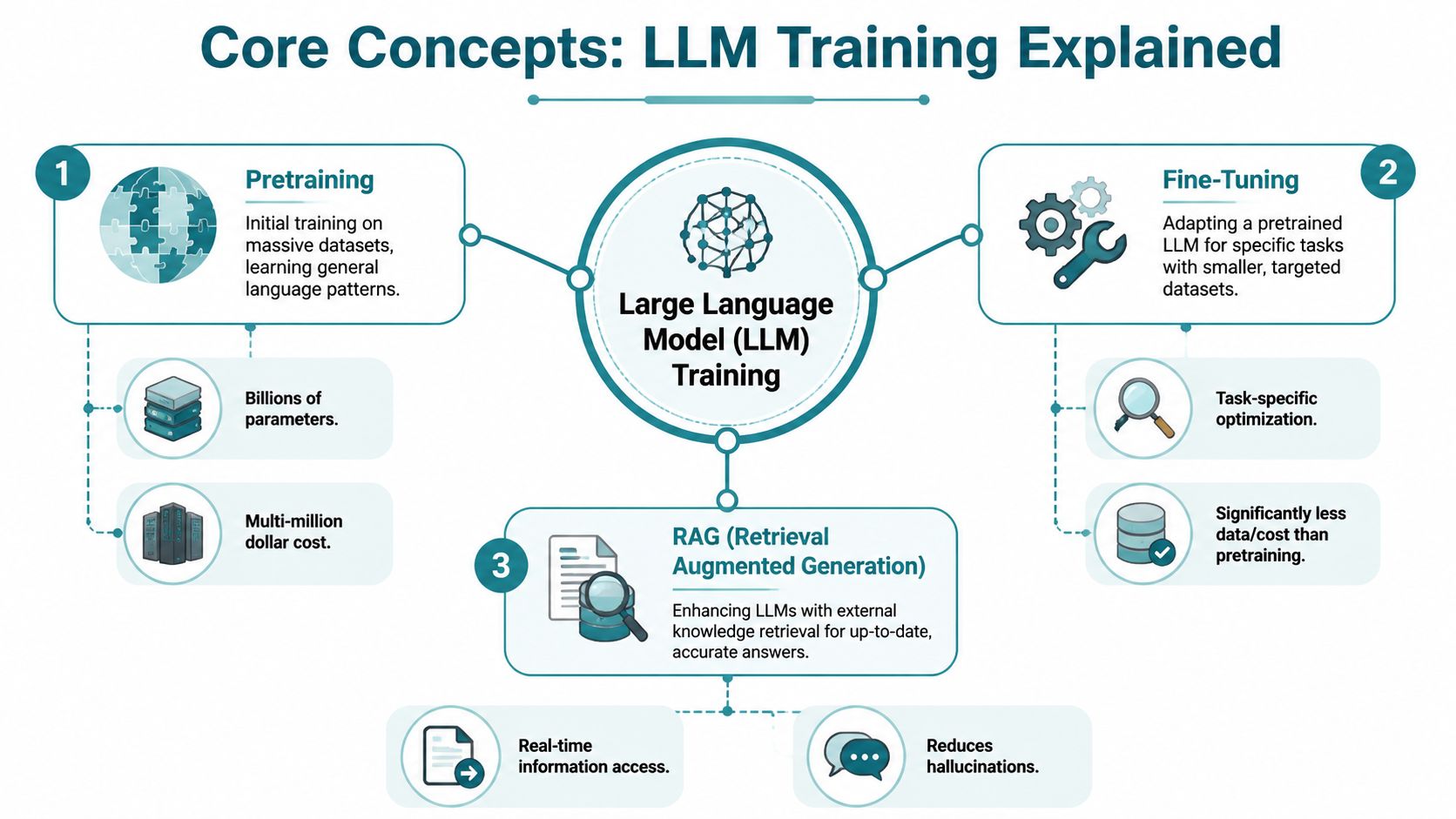
Pretraining builds the foundation
Pretraining creates the base model itself. A team starts with an architecture, feeds it massive text corpora, and trains it to predict language patterns at scale through self-supervised learning.
That process builds general capability: grammar, broad reasoning habits, common facts, and enough pattern recognition to handle many business tasks without customization. It also explains why pretraining is rarely the right commercial choice for a typical company. You are not just improving outputs. You are funding a new foundation model program, with all the data, infrastructure, talent, evaluation, and maintenance that comes with it.
For most companies, pretraining only makes sense if the base models on the market lack the essential concepts your business depends on.
Fine-tuning changes what the model does well
Fine-tuning starts with a pretrained model and adjusts it for a narrower objective. Oversimplification is common at this stage, especially when product teams use fine-tuning as a catch-all term for any model customization.
In practice, there are two different learning goals inside that label:
- Instruction fine-tuning for skill: You teach the model how to perform a task better. That includes extracting fields from contracts, writing in a strict schema, following escalation rules, classifying support tickets, or matching your brand voice.
- Continual pre-training for knowledge: You teach the model domain material it may not already know. That matters in fields with niche terminology, uncommon workflows, or concepts that were underrepresented in the base model's original training data.
That distinction matters more than the usual cost comparison. Skill learning improves behavior. Knowledge learning improves domain coverage. If a base model already understands your world and just needs to follow your process, instruction fine-tuning is often enough. If your company operates in a domain the base model barely saw, behavior tuning alone will not fix the gap.
I usually frame it this way for founders: if the model answers in the wrong format, that is a skill problem. If it does not know what your documents are talking about, that is a knowledge problem.
RAG gives the model access to information without changing weights
Retrieval-Augmented Generation, or RAG, leaves the model weights alone. Instead, it fetches relevant documents at inference time and passes them into the prompt. Those documents might be policies, manuals, product specs, contracts, tickets, or internal wiki pages.
RAG is often the better choice when your challenge is current information, traceability, or private enterprise content. It is also usually faster to ship than model retraining. The trade-off is that you are now building a retrieval system, not just calling a model. Search quality, chunking, ranking, access control, and citation behavior start to matter as much as prompt design. This guide to RAG pipeline architecture shows where those systems usually succeed or fail.
A simple operating model helps:
| Approach | What it teaches | Best use |
|---|---|---|
| Pretraining | General language capability | Building a base model |
| Fine-tuning for skill | Behavior, style, task execution | Narrow workflows and structured outputs |
| Continual pre-training for knowledge | New factual or domain knowledge | Specialized domains with missing concepts |
| RAG | Access to external information | Dynamic knowledge and grounded answers |
The practical mistake is treating all four as substitutes. They solve different problems. If your company needs a model to act differently, fine-tune for skill. If it needs access to changing facts, use RAG. If it lacks the domain concepts entirely, knowledge adaptation may be required.
The Strategic Comparison When to Train vs Fine-Tune
A founder usually reaches this decision after the prototype works well enough to create pressure. The sales team wants a demo next month. Product wants better accuracy on one workflow. Security wants private data handled correctly. The question is no longer whether to use an LLM. It is what kind of learning the business needs to pay for.
Cost matters, but it is rarely the primary decision variable. The better question is whether you need to teach the model a skill, give it access to knowledge, or build a system around both. That distinction has a direct effect on budget, time to market, and long-term maintenance.
Decision Matrix Training vs Fine-Tuning vs RAG
| Criterion | Training from Scratch | Fine-Tuning (PEFT/LoRA) | RAG |
|---|---|---|---|
| Primary goal | Build foundational capability | Improve task behavior on an existing model | Ground responses in external data |
| Best fit | Domains missing from existing model foundations | Narrow tasks, format control, workflow specialization | Fast-changing or document-heavy knowledge |
| Data requirement | Massive unlabelled corpora | Smaller labelled task data | Indexed documents and retrieval pipeline |
| Domain uniqueness tolerance | Highest | Medium, depends on base model coverage | High for facts, lower for missing reasoning patterns |
| Compute burden | Highest | Lower, especially with PEFT | Lower training burden, higher system design burden |
| Maintenance pattern | Expensive model lifecycle | Retrain or refresh for behavior drift | Update corpus and retrieval quality regularly |
| Main risk | Overspending for unnecessary capability | Overfitting or forgetting general skills | Retrieval misses, noisy context, weak grounding |
Start with the type of learning
If the model already understands the domain but performs the task poorly, that is usually a skill problem. Common examples include extracting fields from contracts, following a support workflow, producing structured JSON, or maintaining a specific tone across customer messages. Fine-tuning is often the highest-ROI move because you are shaping behavior, not rebuilding general intelligence.
If the model fails because the domain itself is unfamiliar, the situation changes. Proprietary legal logic, internal taxonomies, industry shorthand, equipment codes, or highly specialized reasoning patterns are not just "more data." They can reflect concepts the base model never represented well in the first place.
That is the gap many buying guides miss. Fine-tuning works best when the base model already has the raw concepts and only needs adaptation. Training, or at least deeper domain adaptation, starts to make sense when your company operates in a knowledge environment that is atypical.
Domain uniqueness is the real filter
Two companies can have the same budget and the same dataset size and still need different strategies.
A SaaS company building a support copilot usually has a familiar language domain. Tickets, help docs, and account notes look close enough to public internet text that a strong base model can adapt quickly. Fine-tuning or RAG will usually cover the business need faster and with less risk.
A pharmaceutical, legal, or industrial business often faces a different problem. The issue is not just private documents. The issue is that the model may misread the logic inside those documents because the domain uses concepts, abbreviations, and reasoning structures that are rare in public pretraining data. In that case, a simple fine-tune can improve surface behavior while leaving the deeper knowledge gap untouched.
This is why I push teams to test for concept failure, not just answer failure. If outputs sound fluent but repeatedly miss domain logic, the architecture choice is probably wrong.
Training from scratch is a business decision, not a model decision
Training from scratch makes sense when your company needs control over the foundation itself. That usually means one of three things: the target domain is poorly covered by public models, the product depends on unique model behavior that off-the-shelf systems cannot provide, or the company expects the model to become a long-term strategic asset.
That is a serious commitment. You are funding data pipelines, training runs, evaluation infrastructure, model governance, and a team that can maintain all of it. For early-stage companies, that is often too much fixed cost before product-market fit is proven.
Fine-tuning sits in a very different budget category. It is an adaptation strategy. You are buying better task performance on top of an existing foundation. For many teams, that is the right trade because it shortens deployment time and limits infrastructure overhead. For organizations planning specialized AI products, this guide to building domain-specific custom LLM models outlines the infrastructure and data questions that show up once the prototype starts turning into a product.
Maintenance changes the ROI
The first deployment cost is only part of the story.
RAG shifts work into retrieval quality, document freshness, permissions, and evaluation of grounded answers. Fine-tuning shifts work into dataset versioning, regression testing, retraining cadence, and rollback discipline. Training from scratch adds the full burden of model ownership, including foundational updates and higher operational risk.
Fine-tuning also has a practical failure mode teams underestimate. A narrow dataset can improve one workflow while weakening broader performance outside that workflow. That risk is manageable, but only if the team tests against both the target task and the surrounding use cases the business still cares about.
Practical rule: Choose fine-tuning when the model needs to act differently. Choose RAG when it needs access to changing facts. Consider deeper domain training only when your company's knowledge and reasoning patterns are meaningfully outside what the base model already knows.
A Deeper Dive into Fine-Tuning Techniques
Once a team decides not to train from scratch, the next question is how much of the model to modify.
Full fine-tuning changes everything
Full fine-tuning updates all model parameters. That gives you maximum control, but it also increases compute needs, operational complexity, and the risk of degrading useful general behavior.
This approach can make sense when the task is highly important, the dataset is strong, and the team can support a more serious training workflow. It's rarely the first move I'd recommend for a company still validating the product.
PEFT methods are what most companies should evaluate first
Parameter-efficient fine-tuning, often shortened to PEFT, changes the economics. Instead of retraining the entire model, methods like LoRA and QLoRA adapt a smaller subset of parameters or inject trainable components into targeted parts of the network.
That's why these methods have become the default recommendation for practical business use. Fine-tuning is far cheaper than training from scratch, and PEFT methods such as LoRA and QLoRA let organizations adapt large models at a fraction of the compute cost of full fine-tuning, as described in this practical guide to LoRA and QLoRA.
What LoRA and QLoRA mean in plain English
Here's the business-level interpretation:
- LoRA: Good when you want targeted adaptation without carrying the cost of changing the entire model.
- QLoRA: Useful when hardware is tighter and you still want meaningful customization.
- Full fine-tuning: Reserved for cases where PEFT doesn't deliver the control or performance you need.
A founder doesn't need to know the math behind low-rank adapters. They do need to know what to ask a technical team:
- What baseline model are we starting from?
- Are we tuning for skill, style, or knowledge?
- Can we run a small LoRA experiment before committing further?
- How will we evaluate whether the adaptation outperforms prompt engineering or RAG?
If your team is assessing implementation paths, this overview of LLM fine-tuning and custom model development gives a practical sense of what production-grade customization work usually includes.
Start with the lightest-weight method that can prove value. In most commercial settings, that means PEFT before full fine-tuning, and fine-tuning before any scratch-training conversation.
Your Practical Decision Framework
A founder usually reaches this point after the same meeting. The product team wants better accuracy, the engineering team wants to avoid a long model project, and the business team wants proof that any extra spend will improve a real workflow.
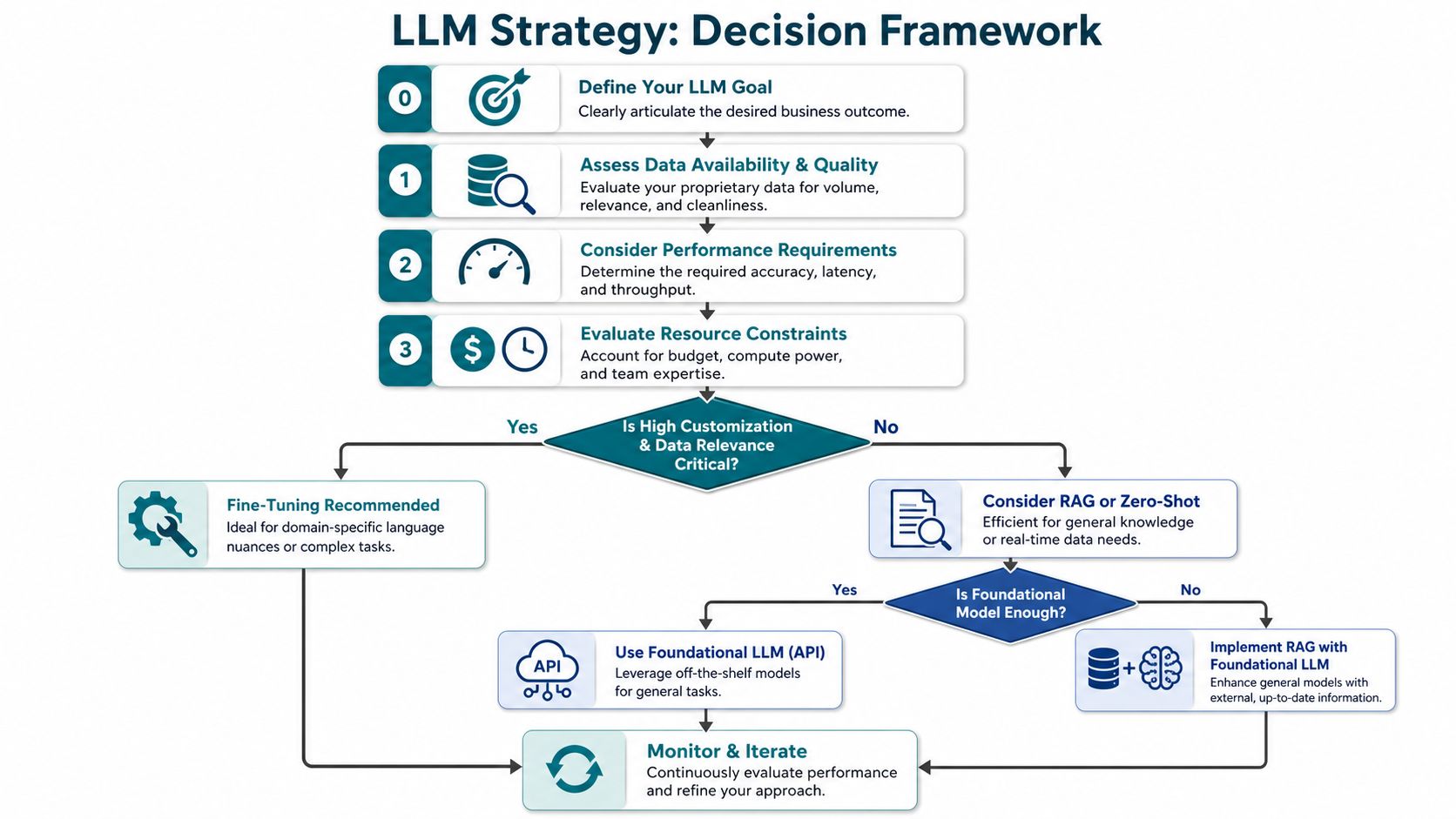
The practical decision is not just about budget or dataset size. It starts with two questions that are easy to miss:
- Are you trying to teach the model knowledge or skill?
- Is your company's data merely private, or genuinely unlike what strong base models have already seen?
Those two questions usually point to the right architecture faster than a long debate about model size.
Early-stage startup building a vertical chatbot
A young SaaS company in insurance, legal, or healthcare often assumes the domain is so specialized that it needs a custom model. In most cases, that is the wrong first move.
If the main problem is access to changing policies, product documentation, contracts, or case guidance, the model does not need to learn that knowledge in its weights. It needs reliable retrieval. Start with a strong base model, a clean document pipeline, and RAG that can cite the right source at the right time.
Fine-tuning enters the picture only after a different problem appears. The assistant gives answers that are technically correct but too verbose, misses a required disclaimer, fails to hand off risky cases, or cannot stay inside a fixed response format. That is a skill and behavior issue, not a knowledge issue.
For this stage, the lowest-risk path is usually:
- Use RAG first for current domain knowledge.
- Add lightweight fine-tuning if tone, structure, or workflow behavior must become consistent.
- Skip scratch training unless you can show the base model fundamentally cannot reason over your domain.
That sequence protects cash and gets to production faster.
Growth-stage company automating internal workflows
Internal automation changes the economics. Email classification, form extraction, case summarization, and document routing are less about broad reasoning and more about repeatable execution.
Here, fine-tuning often pays for itself because the company is teaching a skill. The model needs to produce the same structure every time, follow a narrow decision policy, and reduce human cleanup. If the task can be described with stable examples and reviewed against clear outputs, tuning is often worth testing.
A practical sequence looks like this:
- Start with prompts to verify the base model can perform the task at an acceptable baseline.
- Move to PEFT fine-tuning when output consistency, formatting, or edge-case handling is still weak.
- Add retrieval only if the task depends on live records, policy updates, or customer-specific facts.
The ROI question is simple. If better consistency saves analyst time, reduces rework, or lowers error rates in a workflow that runs every day, tuning usually has a clearer business case than a general chatbot project.
Enterprise with proprietary reasoning or unusual data structures
Some enterprises have a harder problem. Their value sits inside notation, taxonomies, decision logic, or records that do not look much like public web data. Private data alone does not justify training. Genuine representational mismatch might.
Separate the problem into two parts.
First, can the right information be retrieved at runtime?
Second, does the base model already have the cognitive foundation to interpret that information correctly?
If retrieval solves access but the model still misreads the structure, confuses terms of art, or fails on domain-specific reasoning patterns, standard supervised fine-tuning may hit a ceiling. That is the point where continual pretraining becomes a serious option. Full training from scratch still remains rare, because the cost, time, and evaluation burden are high, but some companies do reach that threshold.
This is also the point where governance matters early, not late. Teams handling regulated records or sensitive IP should review architecture choices against a practical set of AI security best practices for model and data handling.
A simple decision lens
Use this sequence when choosing between RAG, fine-tuning, and more foundational training:
- If knowledge changes often, start with RAG.
- If the task requires stable behavior, teach the skill with fine-tuning.
- If your data uses concepts or structures the base model does not handle well, test whether you need continual pretraining.
- If both knowledge and behavior matter, combine methods instead of forcing one model change to do everything.
Match the method to the bottleneck. Use retrieval for changing knowledge. Use fine-tuning for repeatable behavior. Reconsider the base model itself when your domain is genuinely unlike the data it was built on.
Beyond the Model Evaluation Security and Maintenance
A model that demos well can still fail in production. The usual reason isn't hidden in benchmark scores. It shows up in weak evaluation, loose security controls, or no plan for maintenance.
Evaluate against business outcomes
Accuracy alone isn't enough. A support assistant should be judged on answer usefulness, escalation quality, and failure behavior. A document workflow model should be judged on extraction correctness, exception handling, and downstream rework.
Teams should define acceptance criteria before they train anything. That means test sets tied to real workflows, not just synthetic prompts.
Security changes architecture decisions
Model choice and deployment choice are linked. If a company handles regulated documents, customer records, or sensitive internal IP, data flow matters as much as output quality.
That affects whether you use external APIs, private hosting, retrieval over controlled data stores, or self-managed model infrastructure. Security teams should review retention, access control, auditability, and model update processes early. A practical checklist of AI security best practices helps surface the issues that often get ignored until procurement or compliance blocks rollout.
Maintenance is ongoing, not optional
Every customized LLM drifts eventually. Documents change. Policies change. User behavior changes. Input distributions shift. A retrieval system can degrade because indexing quality slips. A fine-tuned model can degrade because the workflow it was trained for no longer matches real usage.
Treat the system like production software with ML attached:
- Monitor failure modes: Track hallucinations, low-confidence outputs, formatting errors, and escalation rates.
- Refresh evaluation data: Update test sets when products, policies, or customer behavior changes.
- Version everything: Prompts, datasets, adapters, retrieval settings, and release criteria.
A custom LLM isn't a one-off project. It's a living system with ongoing operational cost and governance requirements.
Frequently Asked Questions About LLM Customization
Can I fine-tune a model to remove its biases
Fine-tuning can reduce specific biased behaviors, especially if you know the failure cases you want to correct and you have examples of better outputs. It cannot guarantee a bias-free system.
In practice, this is a governance problem as much as a model problem. A narrow fine-tuning set may improve one class of responses while making the model less reliable for another user group or edge case. Teams that handle this well define unacceptable outputs up front, review training data carefully, and test across different user profiles before release.
How long does fine-tuning take
The training run is rarely the slow part. Data cleaning, labeling, prompt formatting, and evaluation usually take longer than the actual fine-tuning job.
Timelines also depend on what the model needs to learn. If you are teaching a stable skill, such as extracting fields from contracts in your required format, fine-tuning can move quickly once the dataset is in shape. If you are trying to teach company knowledge that changes every week, the bottleneck is not training speed. The main issue is that fine-tuning is the wrong tool for fast-changing information, and retrieval will usually deliver better ROI.
Is fine-tuning better than prompt engineering
Prompt engineering is usually the first test because it is faster, cheaper, and easier to reverse. It is the right starting point when you are still learning what users need.
Fine-tuning becomes a better option when the gap is behavioral, not informational. If the model knows the domain terms but still fails to follow your tone, structure, decision rules, or output format, that points to skill learning. That is where fine-tuning tends to pay off. If the problem is missing facts, current product details, or internal documents, prompts and retrieval are usually a better fit.
Should I choose RAG or fine-tuning
Choose based on the type of learning required.
RAG fits knowledge problems. It gives the model access to current documents, policies, catalogs, or records without retraining every time those sources change.
Fine-tuning fits skill problems. It improves how the model performs a repeated task, especially when your company has a distinctive workflow, style, or decision pattern that generic models do not handle well out of the box.
Many teams need both. A support assistant, for example, may use RAG to pull the latest policy and fine-tuning to produce replies in the exact format, tone, and escalation logic your operation requires.
If your team is weighing fine-tuning, RAG, or a custom model strategy, AmasaTech can help you make that decision based on business outcomes instead of hype. Their approach starts with an AI audit, maps the right architecture to your data and workflow, and supports secure deployment for teams that need measurable results rather than another prototype.
